
on this page
-
Markets
-
Services

Simon Peevers
Senior Advisor External Communications, Bristol, United Kingdom contact form+44 1454 667 587
Madeira Terrace in Brighton is believed to be the longest cast iron structure in Europe. Earlier this year Kristina Smith from Construction Management visited the Victorian-era structure and spoke to Keith Brownrigg and Dave Mills from AtkinsRéalis about the painstaking heritage project currently under way.
Outside Brighton’s outdoor beachside swimming pool, Sea Lanes, two people are pointing to something across the road, chatting intently. It is the first section of a rejuvenated Victorian cast iron structure, Phase One of the ambitious Madeira Terrace Restoration project.
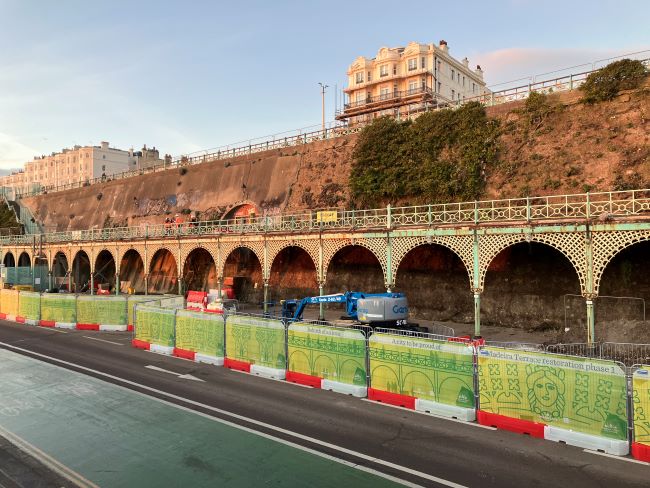
Maderia Terrace, Brighton, before restoration work began. Image: JT Mackley
Designed to provide a covered promenade and a walkway on its deck, the terrace stretches for 151 arches – or 865m – along the east end of the city’s seafront. Supported on the cliff face at the back, and on columns at the front, the deck sits halfway down the cliff with Marine Parade, the A259, above and Madeira Drive and Brighton Beach below.
Contractor JT Mackley & Co has the £12.1m contract to restore 28 arches between the Madeira Shelter Hall, home to music venue and nightclub Concorde 2, and the Royal Crescent steps. The project includes works to the east cliff wall, the installation of a new lift and a new staircase by Concorde 2.
The restoration of the Grade II*-listed structure is a painstaking process, driven by a heritage-first approach. Mackley must carefully dismantle the structure, sending each of the 26 pieces that make up each bay to a specialist foundry to be cleaned, inspected, repaired where necessary, and repainted before being returned and assembled in their original position – with a rigorous testing regime woven in.
“We are working with a material that there isn’t a huge amount of knowledge about out there,” says Brighton & Hove City Council’s programme manager Ian Graham. “How do we garner that knowledge and that expertise? And how do we apply modern design standards? That has been the big technical challenge for us.”
Mackley, which started on site in October 2024, is a civil engineering contractor, which specialises in coastal projects. It has a track record with cast iron structures, delivering the maintenance contract for Worthing Pier and having worked on Eastbourne and Brighton Piers.
But this is a one-off. “It is totally different from anything I have done before,” says Mackley’s contracts manager Mike Clegg, who has almost 40 years’ experience across varied civil engineering projects. “Everything is a learning curve. It’s about finding the best way to do it and then getting it done.”
Although the project is being delivered under a traditional form of contract, JCT Standard Building Contract Without Quantities, Mackley and the design team have worked together to refine many of the details, explains Keith Brownrigg, senior project manager for AtkinsRéalis which is project manager for the scheme.
“It’s been a collaborative approach. We have been fortunate to have JT Mackley on the project because they have been proactive in engaging with the design, challenging the design team, ensuring that what’s getting built is suitable.”
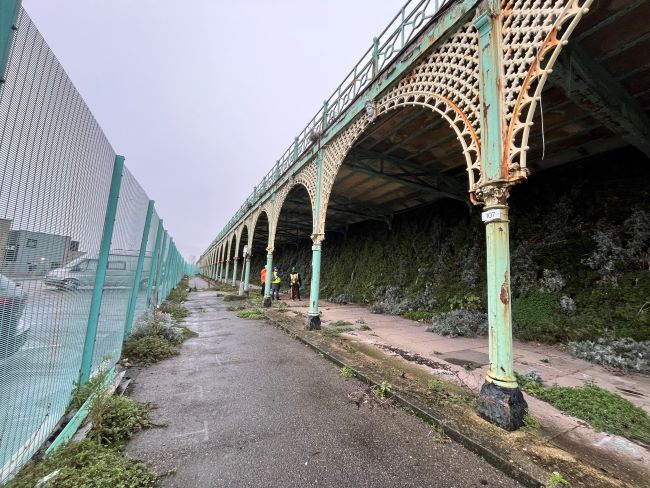
Madeira Terrace arches prior to restoration work starting. Image: JT Mackley
A unique structure
Believed to be the longest cast iron structure of its kind in Europe – possibly in the world – Madeira Terrace was built in two sections, between 1889 and 1897. Becoming progressively unsafe due to the deteriorating condition of the structure, the whole area has been behind a security fence since 2015.
The length being restored under Phase One sits within the older section, with that portion chosen to optimise movement between Marine Parade and the beachfront, explains the council’s project manager Abigail Hone.
“With the design team, which came on board in early 2020, we were looking at the hinterland of the Terrace, and what was happening development wise on the sea side,” they say. “We looked at how people get here, what were the dominant pedestrian routes.”
The striking new lift, designed to acknowledge, but not mimic, the Victorian Madeira Shelter Hall lift – in need of costly repairs and not in use – is a vital part of the scheme, opening up access to the seafront for people using mobility scooters and prams. “Accessibility is hugely important to Historic England,” notes Graham. “Without the lift, we probably wouldn’t have got their investment.”
Historic England has provided £750,000 funding towards the restoration, with £500,000 coming from a 2017 crowd-funding campaign, boasting backers including Fat Boy Slim, Suzy Eddie Izzard and Damon Hill. The council allocated over £10m including £300,000 from a carbon neutral fund – justified by the extensive reuse of the cast iron. Original plans for Phase One encompassed 40 arches and the refurbishment of Royal Crescent steps, but inflationary pressures forced the council to reduce the scope, says Graham.Mackley’s contract includes works to stabilise the original east cliff wall, reinforced by the Victorians in the 1830s with a mixture of stone, brick and render, a Brighton-specific material known as bungaroosh. This became the Green Wall – much loved by local residents – after the Victorians introduced Japanese Spindle plants in 1872, pre-dating the Terrace.
One section of the Green Wall in Phase One has remained intact, without works to the bungaroosh; an experiment, explains Graham. The rejuvenated sections will be greened with new plants, grown from the base of the wall onto trellises fixed to the new concrete face.
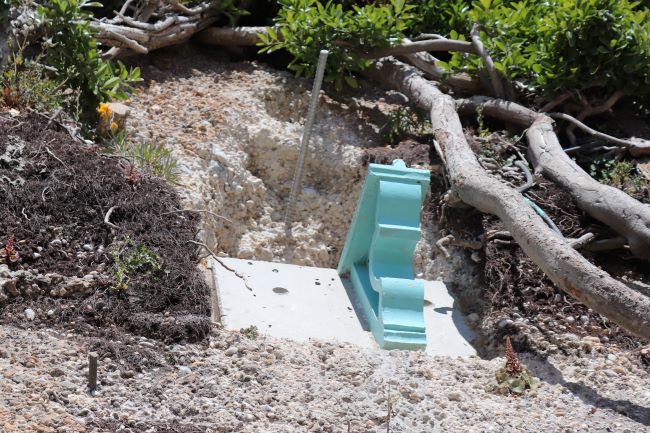
A retained section of the Green Wall, showing the cast iron corbels. Image: JT Mackley
Careful disassembly
Mackley started on site in November 2024, removing asbestos from joints in the wall and deck, taking down most of the Japanese Spindles and other plants that had colonised the wall and clearing the site. The site compound is small, with most materials stored offsite.
Having removed lead paint from the joints in the cast iron structure, Mackley began the careful dismantling of the arches in February 2025. Cast Iron Welding Services (CIWS), the foundry tasked with restoring the cast iron elements, were on site to advise the team who were all direct Mackley employees, to ensure close control of the delicate operation, says Clegg.
CIWS had carried out earlier investigative works on the cast iron for the Council, although the choice of foundry was left to Mackley. “On visiting them and seeing that they had a good understanding of the project and of what was involved, I took the decision to work with them,” says Clegg.
Starting with the careful munching of the concrete deck, from the middle outwards to limit vibration in the cast iron, the dismantling process saw Mackley’s team label, measure, weigh and test every element with a magnet – as some have been replaced by aluminium over the years. All information is recorded on an app developed within the Procore platform.
The initial assumption was that some of the cast iron pieces will require no repair work at all, others will have cracks that CIWS will repair using gas fusion welding, a few may need recasting altogether. With its knowledge of cast iron, and of this particular structure, CIWS agreed to a fixed price contract.
“The main pressure on price for them is the balance between recasting and repair,” comments Graham. Recasting requires raw material and far higher temperatures, whereas repair requires skilled work that is labour intensive.
The worst case so far, says Clegg, was one of the spandrels which had 26 breaks in it. With a few elements yet to be processed, none had needed recasting by mid-April, a process which takes 26 weeks and hence could yet have a knock-on effect to the overall programme.
After CIWS receive the cast iron elements at their Coalville facility, they grit blast each item, spray them with white paint, check measurements and mark up where repair is needed. Looking at a photo of one of the masks that sit either side of the keystone – believed to be Aphrodite and Poseidon – the metal could have been cast yesterday.
It’s hard to believe these are the same pieces on view in the existing structure. Hone explains that it is the wrought iron bolts that have rusted and expanded, causing fractures in some elements as well as extensive staining. Layers of paint – up to 28 in places – further distort the shapes and lines.
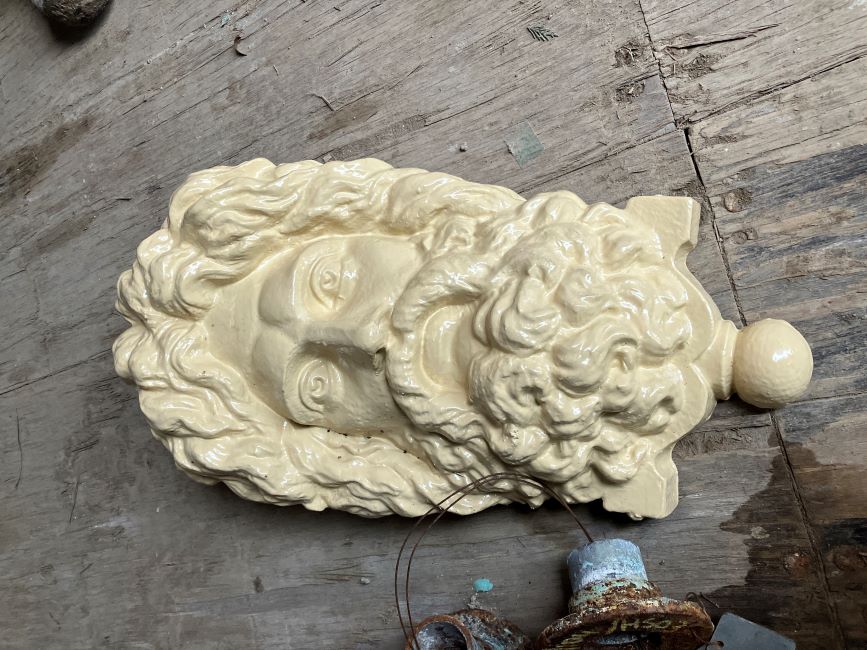
One of the restored masks, thought to be an image of the Greek god Poseidon.Image JT Mackley
Structural engineer HOP has had the difficult task of proving CIWS’ confidence in the cast iron. They have worked collaboratively with conservation engineers The Morton Partnership and Mann Williams to develop a robust testing regime.
“HOP has had to build a unique structural model and prove by first principles that it stands up,” says Dave Mills, regional director at AtkinsRéalis. The deployment of innovative techniques, such as the non-intrusive dynamic testing, have proved invaluable in identifying issues and building confidence in the original century old cast iron.
In a process that has evolved, all the items undergo dynamic testing, with some subject to compression and tensile testing. Before they can be re-erected live load testing takes place; elements for the first six bays have been fully tested, explains Clegg, moving to 50%, 20% and 15% as the project progresses.
“The testing regime has been more intensive than we expected to prove we can safely reuse,” says Graham. “It’s tricky… we have got to get it right, but it’s getting that balance.”
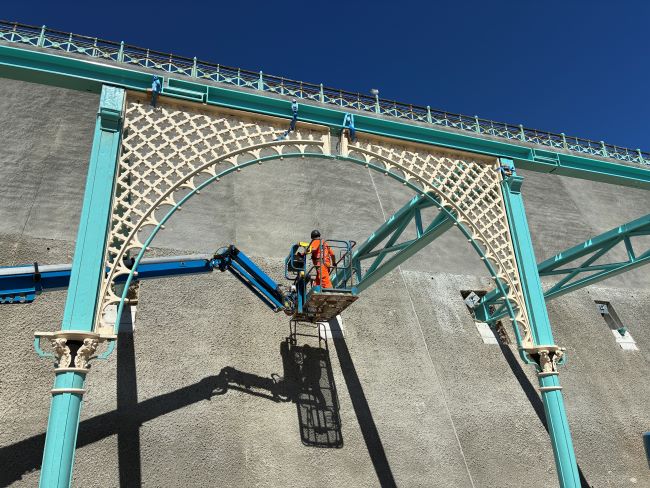
One of the restored cast iron arches in the Madeira Terrace. Image: JT Mackley
Surprises
There have been plenty of other issues to be addressed at monthly meetings with the design team, and Mackley’s six-person in-house technical services team has fed into the process.
Super-hard flints in the bungaroosh mean that coring through it has been impossible. The project team has had to devise new ways of installing steel bars into the cliff wall, and new ways to validate their capacity. Some of these will support the new terrace deck, some will hold trellises and some are for a reinforcing mesh below new layers of structural concrete.
The surprising resilience of the bungaroosh and the decision to pin rather than remove historic repairs has led to welcome savings. With a point cloud survey, Mackley discovered that the original wall had receded less than expected. Working with contractor Shotcrete Services, the new approach required less sprayed concrete.
Mackley also discovered, during dismantling, that the cast iron corbels set into the cliff to support the structure were not as the original Victorian drawings suggest; they have an additional fin that sticks into the wall, which meant that Mackley had to adapt the installation sequence.
Re-erecting the first of the rejuvenated bays has also added to the ‘lesson learned’ list. The introduction of new steel elements – the front beam and a key stone on which the masks will be hung – caused tolerance headaches for Mackley.
“The columns are not straight; they are like bananas. But we don’t know which way they bend until we are erecting them, so the spandrels don’t quite align,” explains Clegg. The solution has been to elongate the bolt holes in the new steel beams.
Mills notes that the designers have devised details to separate cast iron and steel at joints, to avoid any risk of bi-metallic corrosion. “We are building back better,” says Graham.
Given the complexities of restoring the Victorian structure, it is perhaps surprising to learn that the construction of the lift shaft has caused the most co-ordination headaches. “It has been one of the most complex parts, design wise,” says Hone.
Clad in four types of brick – two red, a black glazed header and glass – which have been laid with lime mortar, the shaft is a steel-framed structure founded on continuous flight auger (CFA) piles with the lift operated by a pneumatic ram housed in a plant room at the lowest level. Steel lintels, clad with brick slips, transfer the load from the brick wall to the steel frame at four points.
“Getting the steel frame, brickwork, lift, heritage, mechanical and electrical parties all to talk to each other and get everything coordinated has been a real challenge,” says Mills. “It has been an iterative process; you solve one problem and create another.”
By mid-April, the lift shaft structure was well advanced with the brickwork almost complete and a bridge between the lift and pavement at the upper level in place. The copper roof installation was about to start, followed by the windows a few weeks later and the fitting of the lift set to begin early summer 2026.
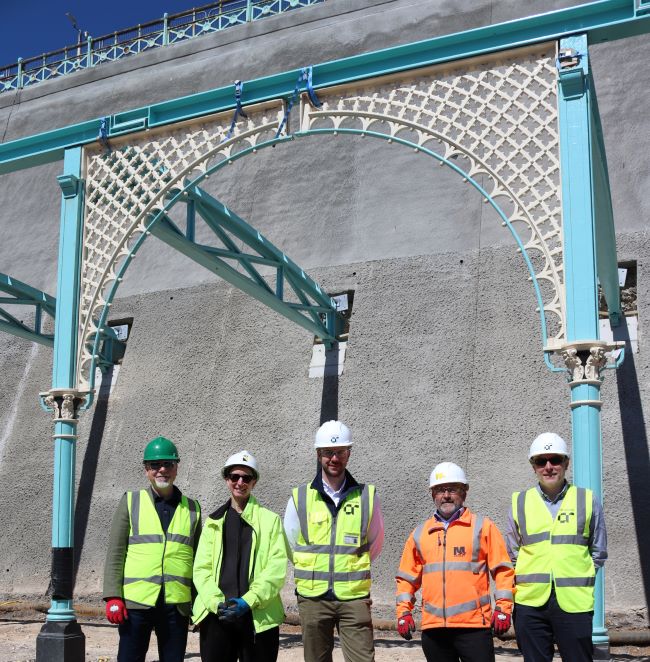
Project team with one of the restored cast iron arches. Image JT Mackley
Cost control
The biggest challenge on the project, say Hone, has been “controlling the costs. We are in that place, as a local authority, where we just don’t have the luxury of throwing more money at it.”
There have been some savings on the job. For instance, Mackley proposed an off-the-shelf kerb rather than a heritage one, which come with a lower capital cost and a lower maintenance cost.
However, there will be some difficult conversations to come. “We are currently assessing the variations associated with the contract at this time,” says Graham.
Even more of a vexing problem is how the restoration of the remaining arches, and associated access, will be funded. This is a matter which comes in part under the remit of the newly formed Seafront Development Board, a group of private and public sector professionals developing a vision for the seafront which includes ways to attract much needed investment.
The many discoveries and lessons from Phase One will reduce some risks and drive some efficiencies on future phases. And this first section, when completed, will demonstrate the value of this heritage structure to Brighton & Hove, and beyond.
Madeira Terrace Restoration Phase One
Client: Brighton & Hove City Council
Project manager: AtkinsRéalis
Architect: Purcell
Civil, and structural engineer: HOP
Conservation Engineers: The Morton Partnership
M&E design: Stantec
Landscape architects: Landscape Projects
Cost consultant: MGAC
Business planning: Fourth Street
Contractor: JT Mackley & Co
Construction cost at tender award: £12.1m
Form of contract: JCT Standard Building Contract Without Quantities
On site: November 2024 to Winter 2026
Main subcontractors
Cast Iron restoration: Cast Iron Welding Services (CIWS)
Cast Iron Load Testing – Mann Williams
Piling: Green Piling
Sprayed Concrete: Shotcrete Services
Brickwork: K & T
Copper roofing: Eco Roofing
Lift: Lift Design
Mechanical and electrical: Simpson Electrical
New Cast Iron: FSE
Concrete Works: WestConn
This article first appeared in Construction Management in June 2026
Please note that you are now leaving the AtkinsRéalis website (legal name: AtkinsRéalis Group inc.) and entering a website maintained by a third party (the "External Website") and that you do so at your own risk.
AtkinsRéalis has no control over the External Website, any data or other content contained therein or any additional linked websites. The link to the External Website is provided for convenience purposes only. By clicking "Accept" you acknowledge and agree that AtkinsRéalis is not responsible, and does not accept or assume any responsibility or liability whatsoever for the data protection policy, the content, the data or the technical operation of the External Website and/or any linked websites and that AtkinsRéalis is not liable for the terms and conditions (or terms of use) of the External Website. Further, you acknowledge and agree that you assume all risks resulting from entering and/or using the External Website and/or any linked websites.
BY ENTERING THE EXTERNAL WEBSITE, YOU ALSO ACKNOWLEDGE AND AGREE THAT YOU COMPLETELY AND IRREVOCABLY WAIVE ANY AND ALL RIGHTS AND CLAIMS AGAINST ATKINSRÉALIS, AND RELEASE, DISCHARGE, INDEMNIFY AND HOLD HARMLESS ATKINSRÉALIS, ITS OFFICERS, EMPLOYEES, DIRECTORS AND AGENTS FROM ANY AND ALL LIABILITY INCLUDING BUT NOT LIMITED TO LIABILITY FOR LOSS, DAMAGES, EXPENSES AND COSTS ARISING OUT OF OR IN CONNECTION WITH ENTERING AND/OR USING THE EXTERNAL WEBSITE AND/OR ANY LINKED WEBSITES AND ANY DATA AND/OR CONTENT CONTAINED THEREIN.
Such waiver and release specifically includes, without limitation, any and all rights and claims pertaining to reliance on the data or content of the External Website, or claims pertaining to the processing of personal data, including but not limited to any rights under any applicable data protection statute. You also recognize by clicking “Accept” that the terms of this disclaimer are reasonable.
The information provided by Virtua Research cited herein is provided “as is” and “as available” without warranty of any kind. Use of any Virtua Research data is at a user’s own risk and Virtua Research disclaims any liability for use of the Virtua Research data. Although the information is obtained or compiled from reliable sources Virtua Research neither can nor does guarantee or make any representation or warranty, either express or implied, as to the accuracy, validity, sequence, timeliness, completeness or continued availability of any information or data, including third-party content, made available herein. In no event shall Virtua Research be liable for any decision made or action or inaction taken in reliance on any information or data, including third-party content. Virtua Research further explicitly disclaims, to the fullest extent permitted by applicable law, any warranty of any kind, whether express or implied, including warranties of merchantability, fitness for a particular purpose and non-infringement.
The consensus estimate provided by Virtua Research is based on estimates, forecasts and predictions made by third party financial analysts, as described above. It is not prepared based on information provided by AtkinsRéalis and can only be seen as a consensus view on AtkinsRéalis' possible future results from an outside perspective. AtkinsRéalis has not provided input on these forecasts, except by referring to past publicly disclosed information. AtkinsRéalis does not accept any responsibility for the quality or accuracy of any individual or average of forecasts or estimates. This web page contains forward-looking statements based on current assumptions and forecasts made by third parties. Various known and unknown risks, uncertainties and other factors could lead to material differences between AtkinsRéalis' actual future results, financial situation, development or performance, and the estimates given here.
Downloads
Trade releases